The Election That Broke the Internet, Before the Internet Broke the Election
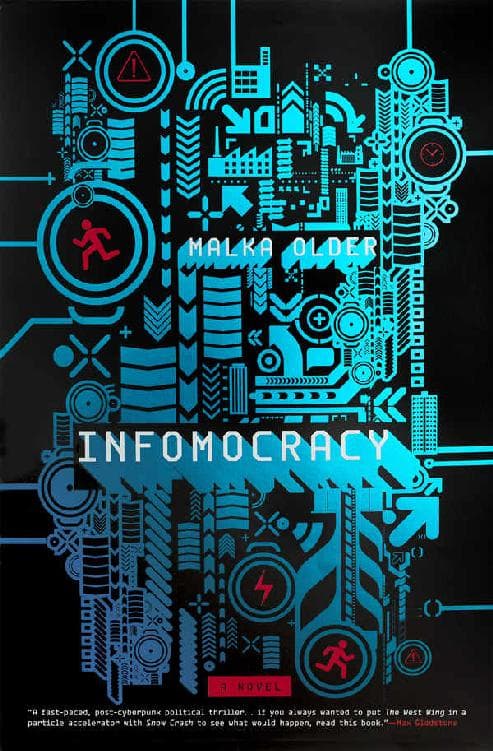
Malka Older wrote a novel about an election being sabotaged by a coordinated attack on the information infrastructure that undergirds democracy, and she published it in 2016 — the year the real world began its own extended experiment in exactly that scenario, though with cruder tools and messier results. The central conceit of *Infomocracy* is a global micro-democracy organized into "centenals" of 100,000 people, each choosing its own government from competing political brands, all held together by a neutral arbiter called Information — a hybrid of Google, the UN, and the Associated Press, granted a monopoly on truth. In 2016 this read as speculative extrapolation. In 2026, after a decade of platform collapse, algorithmic radicalization, deepfake campaigns, and the spectacular failure of any institution to serve as a credible neutral broker of fact, it reads as a document of longing. Older wasn't predicting the future so much as articulating a desire — for a world where someone, anyone, could be trusted to hold the center — and then stress-testing it to destruction.
What the book gets right is almost uncomfortably specific. The Liberty party's strategy of flooding channels with war rhetoric to spike poll numbers mirrors the engagement-driven extremism that became the dominant mode of political communication by 2020. The Information blackout on Election Day — infrastructure targeted, communications severed, voters unable to verify anything — is a scenario that cybersecurity analysts have been war-gaming for years and that several nations have now experienced in partial form. The novel's depiction of a society so dependent on continuous data flow that a few hours of outage produces social disintegration anticipates the real psychological and civic fragility exposed by every major platform outage and internet shutdown from Myanmar to Sudan. Older also understood, early, that the most dangerous form of election interference isn't changing votes but changing the *announcement* of results — the manipulation of perception rather than tabulation. That insight aged like prophecy.
But the blind spots are revealing. The book's central assumption — that a single, trusted, quasi-governmental entity could achieve and maintain a monopoly on verified information — was already strained in 2016 and is now almost quaint. The real trajectory has been the opposite: fragmentation, not consolidation; a thousand competing epistemologies, not one. Older imagines corporate governments (PhilipMorris running centenals, essentially) but treats them as just another flavor of governance rather than reckoning with the deeper capture of regulatory infrastructure by private capital that has actually occurred. The novel is also notably thin on artificial intelligence. Information is staffed by human analysts, human monitors, human field agents. The idea that the information ecosystem's greatest threat would be a rogue employee rather than an autonomous system generating synthetic content at scale reveals the book's 2016 vintage more than anything else. There is no GPT in this future. No algorithmic curation. The humans are still in the loop, and the loop is still legible.