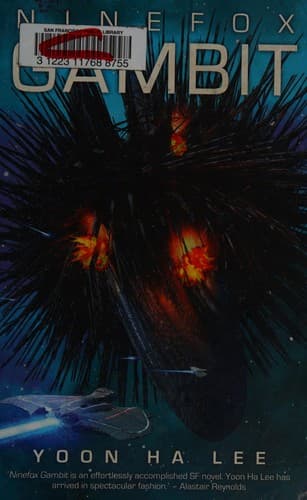
The Calendar Is the Weapon
Ten years on, the most unsettling thing about *Ninefox Gambit* is not its body count or its undead general riding shotgun in a captain's skull. It is the premise that consensus itself is a technology — that a society's shared agreement about how reality works can be weaponized, that calendrical orthodoxy literally powers the guns. In 2016 this read as elaborate metaphor. In 2026, after years of watching algorithmic consensus shape what people can see, say, buy, and believe, it reads as something closer to a systems diagram. Yoon Ha Lee built a galaxy where heresy isn't just punished because it offends; it's punished because it degrades the infrastructure. Change the calendar, change the physics. We don't have exotic weapons keyed to shared belief, but we do have economies, information ecosystems, and political coalitions that function only so long as enough people agree to the same operating assumptions. When that agreement fractures — when the calendar rots — the formations stop working. Lee saw that with remarkable clarity.
The hexarchate's response to heresy maps uncomfortably well onto the governance logic of 2026: a distributed authoritarian system that presents itself as rational necessity. The hexarchs don't frame suppression as cruelty. They frame it as maintenance. The calendrical regime must be preserved because the alternative is that nothing functions — not medicine, not communication, not defense. This is the argument of every platform that deplatforms, every state that restricts in the name of stability. Lee's genius was making the argument partially true within the fiction. The exotic technologies genuinely do depend on consensus. The high calendar genuinely does enable things people need. This is what makes the Liozh heretics' nascent democracy so threatening and so poignant: they are attempting to change the operating system while the machine is running, and they know it might crash. The hexarchate's Vidona faction — torturers elevated to institutional necessity — remains the book's coldest insight. Torture as calendrical maintenance. Atrocity as IT support.
What the book did not anticipate, or chose not to explore, is the role of non-human intelligence in reshaping consensus. The servitors are there — semi-autonomous machines with their own secret communication networks and quiet agendas — but Lee treats them as a subplot, a gentle irony at the margins. In 2026, with large language models and autonomous systems actively participating in how information is generated, filtered, and believed, the servitors feel like a missed center of gravity. They are the most interesting political actors in the hexarchate, and the novel knows it but doesn't quite commit. Lee also assumed, as many writers of the mid-2010s did, that the primary axis of oppression would remain institutional and military rather than informational and epistemic. The hexarchate controls through formations and remembrances, through spectacle and physical coercion. It does not seem to have a sophisticated propaganda apparatus beyond the calendar itself. In a decade defined by information warfare, this feels like a gap — though one could argue the calendar *is* the propaganda, so total it needs no supplement.