The Catastrophe That Wasn't on the List
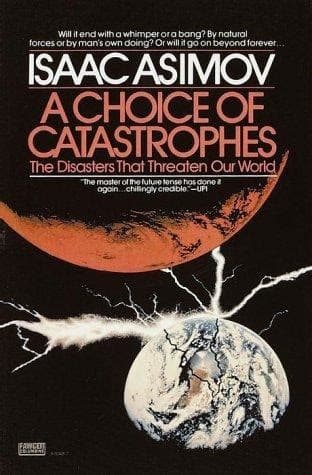
Asimov's taxonomy of doom is a marvel of Enlightenment confidence dressed in apocalyptic clothing. Published the same year as the Three Mile Island accident, *A Choice of Catastrophes* proceeds from the largest possible frame — the heat death of the universe — down through stellar collapse, asteroid impacts, ice ages, and population explosion, arriving finally at the threats humans pose to themselves. The organizational principle is elegant: five classes of catastrophe, ranked by scale and proximity. The implicit argument is that the farther away a threat sits in space and time, the less it should concern us. What should concern us, Asimov insists, is what we're doing to ourselves right now. He was right about that, and spectacularly specific about some of the mechanisms. The population chapter reads like a prophecy partially fulfilled — eight billion people on Earth as of 2022, resource competition intensifying, the mathematics of exponential growth still not internalized by most political systems. His warnings about nonrenewable resource depletion anticipated the rare earth mineral anxieties that now shape semiconductor geopolitics. His discussion of organized warfare as a consequence of agriculture, surplus, and social stratification remains a cleaner explanation than most offered by contemporary evolutionary psychology. And his offhand treatment of the Tunguska event as evidence that cometary impacts are not merely theoretical was vindicated in 2013, when a bolide exploded over Chelyabinsk and injured over a thousand people. The Planetary Defense community that now exists — complete with NASA's DART mission, which successfully altered an asteroid's orbit in 2022 — is essentially the institutional response to the class of threat Asimov described with calm precision forty-seven years ago.
What Asimov could not see, or chose not to see, is what makes the book most useful now. Climate change appears in the text only as a natural phenomenon — ice ages, volcanic winters, the Maunder minimum. The greenhouse effect was already understood in 1979; the first major scientific reports on anthropogenic warming were circulating. But Asimov, whose faith in technological civilization was structural rather than sentimental, treated the atmosphere as a stage for natural variability, not as a system humans were actively destabilizing. This is the book's central blind spot, and it is enormous. The catastrophe that now dominates global policy — a slow-moving, human-caused alteration of Earth's climate system — falls between his categories. It is neither a cosmic event nor a simple resource depletion problem nor a war. It is a systems failure, and Asimov's framework, for all its breadth, has no class for systems failures. Similarly absent: pandemics. He discusses threats from smaller organisms in terms of evolutionary competition, but the idea that a novel virus could shut down global civilization for years, kill millions, and reshape political order — as COVID-19 did beginning in 2020 — doesn't register as a catastrophe class. Biological threats are subsumed into the category of species competition, which misses the point entirely.