The Boys Who Blew Things Up Before It Was a Felony
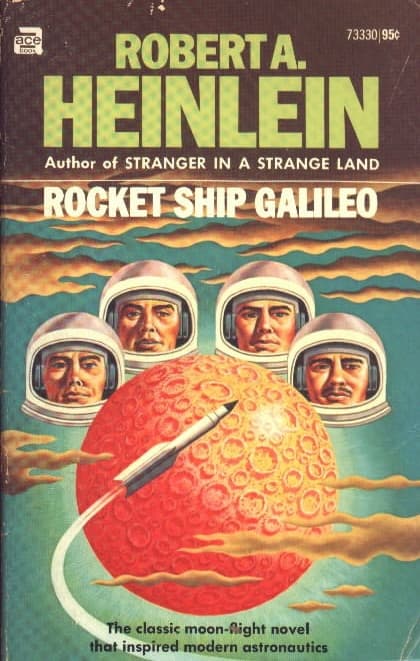
Heinlein's first juvenile novel opens with an explosion and never quite recovers from the honesty of that moment. Three teenage boys — bright, resourceful, casually reckless — detonate their homemade rocket engine in a field and then have to deal with the wreckage, the injured stranger, and the dawning awareness that ambition has consequences measured in property damage and liability. Published in 1947, two years after Hiroshima and twelve years before NASA existed, *Rocket Ship Galileo* treats amateur rocketry as a plausible on-ramp to space. In 2026, we watch teenagers build cubesats and launch amateur rockets under FAA waivers, so the instinct was correct. What Heinlein couldn't see — or chose to ignore — was how thoroughly the regulatory state would intervene between a boy's backyard and the sky. His kids operate in a landscape where a landowner's irritation is the primary obstacle, not ITAR compliance or ATF scrutiny. The book's vision of accessible space is both vindicated by the commercial launch revolution and mocked by the sixty years of bureaucratic encrustation that preceded it.
The blind spots are the ones you'd expect and a few you wouldn't. The cast is all-male, all-American, and possessed of an easy confidence that the universe will yield to competence and good character. There are no girls in the workshop. There is no anxiety about who gets to touch the future. Heinlein's boys are scrappy but never poor, clever but never marginalized — they inhabit a postwar meritocracy that existed more in aspiration than in fact. The injured stranger near the test site introduces a faint note of consequence and moral complexity, but the book doesn't linger there. It wants to move forward, upward. This is the ideology of 1947 distilled: the war is over, the atom is split, and the only question is who builds the next thing first. That the answer might be "a government agency staffed by former Nazi engineers" is a possibility the novel dances around with more prescience than it's usually credited for, given its later plot developments involving lunar Nazis — a premise that seemed absurd for decades and now reads as an uncomfortably sharp metaphor for Operation Paperclip's real moral compromises.
What hits differently now is the sheer tactile detail of the failure. The rocket blows up. The boys don't give up. In an era of SpaceX's "rapid unscheduled disassembly" culture, where iterative failure is a branding strategy, Heinlein's insistence that you learn by breaking things feels less like a children's adventure trope and more like a design philosophy that took seventy years to become respectable in the aerospace industry. Elon Musk did not invent the idea that rockets should blow up on the way to working. Heinlein wrote it down for twelve-year-olds in 1947. The chapter's attention to the boys' emotional response — the deflation, the pragmatic pivot to damage control — is more psychologically honest than most golden-age SF bothered to be. These are not heroes. They are kids with singed eyebrows trying to figure out what to tell the adults.