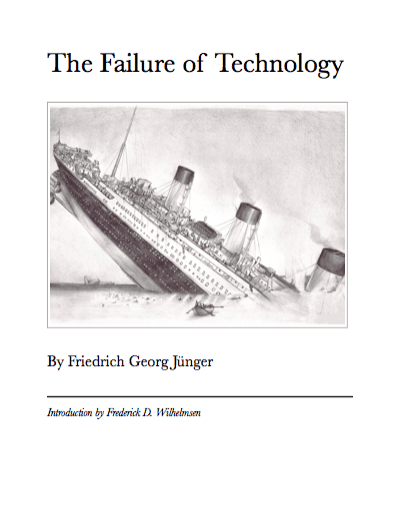
The Hungry Machine at Eighty
Friedrich Georg Jünger finished this book in the ruins. Written during the war, published in 1946 when German cities were still rubble, *Die Perfektion der Technik* arrived wearing a title — rendered in English as *The Failure of Technology* — that its own argument barely supports. Jünger does not really think technology failed. He thinks it succeeded, perfectly, at what it was always doing: consuming. "The machine gives a hungry impression," he writes. "And this sensation of a growing, gnawing hunger, a hunger that becomes unbearable, emanates from everything in our entire technical arsenal." The bottle-blowing machine produces more bottles than the bottle blower, yes, but comparing the two is "childish and an insult to intelligence" — the machine presupposes an entire apparatus, an immense web of extraction and labor, and "every advance in mechanization brings with it an increase in manual labor." The burden doesn't vanish; it migrates, typically to populations "who have no part in the invention of the technical organization." Eighty years later, a reader in 2026 can look at the cobalt mines of the Congo feeding the battery supply chains of Shenzhen and find this sentence waiting for them, fully dressed.
What Jünger built here is not a critique of specific machines but a metaphysics of appetite. Technology doesn't create wealth; it rationalizes scarcity. It doesn't liberate workers; it makes them interchangeable, "as interchangeable as are the parts of his machine," and their very mobility becomes the mechanism of their capture. Leisure freed by automation is hollow — "an *otium sine dignitate*" — because the spiritual capacity to inhabit leisure has already been consumed by the apparatus that supposedly produced it. Total war is not an aberration of technology but its logical expression: "Technical progress now drops the economic mask it had been wearing in the early days of technical organization. Technically organized work becomes preparation for war." These claims were incendiary in 1946. They also describe, with eerie composure, the world of 2026, where gig platforms have perfected the interchangeable worker, where the attention economy devours the leisure it nominally creates, and where semiconductor supply chains have become explicit instruments of geopolitical coercion. Jünger got the shape right. He saw that nature reserves — land "fenced in, and studded with *verboten* signs" — are monuments to destruction, not its opposite. He saw that social security organizations grow in proportion to declining actual security, a vicious circle in which "our age is devouring its own security." He even saw, in his chapter on photography, that "the rising tide of copied reality contains an element of self-deception" — a sentence you could engrave on the front door of any generative-AI company.