The Genius in the Clean Room and the Racketeer in the Coven
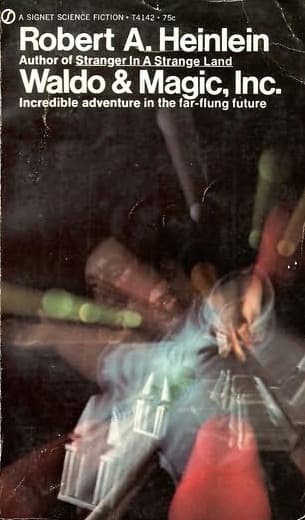
Heinlein published these two novellas separately in 1940 and 1942, then bound them together in 1950 under a title that sounds like a law firm for people who've given up on consensus reality. The pairing is stranger than it first appears. "Waldo" is hard science fiction about a disabled genius who solves an energy crisis from his orbital habitat. "Magic, Inc." is a Depression-era fantasy about a building materials dealer fighting a protection racket run by literal demons. They share almost nothing in plot, tone, or furniture. What they share is a single obsession: what happens when the systems everyone depends on are captured by forces that operate beyond public understanding, and the only people who can fix things are cranks, outcasts, and people the establishment would rather not call.
The prescience of "Waldo" is by now well-documented — the remote manipulator arms used in nuclear facilities and surgical robotics were literally named after Heinlein's character, one of the rare cases where fiction didn't just anticipate technology but branded it. Less noted is the story's portrait of infrastructure fragility. Stevens faces cascading failures in a power grid nobody fully understands, maintained by engineers who've lost touch with first principles, managed by executives who care more about liability than root cause. Swap "deKalb receptors" for any number of real-world systems — power grids, cloud computing stacks, algorithmic trading platforms — and you have the 2020s in miniature. The detail that lands hardest now is that the failures aren't caused by sabotage or incompetence but by a subtle environmental shift nobody noticed because the system had been working fine for so long. That is the story of every infrastructure crisis of the last decade. What Heinlein couldn't imagine, or chose not to, is that the genius called in to fix things might himself be the product of the same institutional rot — that there might not be a Waldo waiting in orbit, only committees.
"Magic, Inc." reads differently now than it possibly could have in 1942. A cartel moves into a fragmented market of independent practitioners, offers "protection," then uses regulatory capture — literally pushing a licensing bill through the state legislature — to establish a legal monopoly. The protagonist fights back not through market competition but by assembling a ragtag coalition that includes a Black half-demon, an old woman with genuine power, and a businessman willing to risk his livelihood. It's a libertarian fable, obviously. But in 2026, after watching platform monopolies absorb entire creative economies, after watching gig-work companies write their own labor laws through ballot initiatives, the mechanism Heinlein describes — consolidation disguised as consumer protection, licensing as exclusion — feels less like allegory and more like a playbook someone actually used. The story's blind spots are equally instructive. The female characters exist to be competent but secondary. The racial politics are handled with a kind of studied broadmindedness that was progressive for 1942 and is now mostly interesting as a fossil of what "trying" looked like. And Heinlein assumes, as he almost always does, that individual competence and moral clarity are sufficient to defeat institutional corruption. That the good guys win by being smarter and braver, not by building durable counter-institutions. History has not been kind to this assumption.