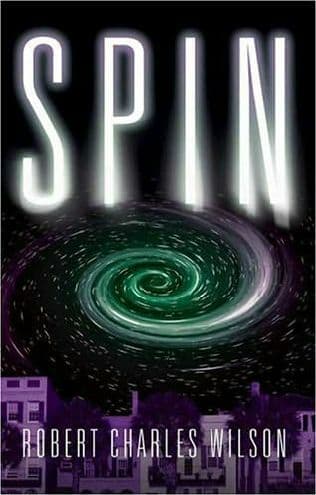
The Terrarium and the Clock
Wilson's trick was simple, and devastating: he made the apocalypse slow. Not a bang but a countdown measured in geological time, experienced at the pace of a human life. The Spin membrane doesn't destroy Earth—it preserves it, like a specimen under glass, while the universe outside ages billions of years in decades. What kills you is the knowledge. The stars go out, and then you have to keep going to work. In 2006, this was a thought experiment. In 2026, it reads like a clinical description of how we actually live. We have our own membrane now—not alien, not engineered, but just as effective at sealing us inside a bubble where the consequences of our choices unfold on timescales we can perceive but cannot emotionally process. Climate projections, demographic curves, the half-life of microplastics. Wilson understood that the hardest apocalypse to survive is the one that gives you time to think about it.
What the book got right is the fracturing. Not the specific politics—Wilson's near-future America is recognizably post-9/11, with its security apparatus and its faith-based consolations, and the Chaykin administration reads as a generic authoritarian drift rather than anything as strange as what actually happened. But the social topology is precise. Diane's flight into millenarian religion, Jason's flight into technocratic problem-solving, Tyler's flight into quiet competence and emotional avoidance: these are the three dominant responses to existential threat that the last twenty years have confirmed. The preppers, the engineers, the people who just keep showing up for their shifts. Wilson saw that these responses would not converge. That families would split along these lines. That the person building the rocket and the person praying for rapture might be twins. The novel's emotional core isn't the Spin—it's the Lawton family dinner table, where everyone knows the sun is dying and nobody can agree on what that means.
The Martian terraforming subplot has aged into something Wilson couldn't have intended. In 2006, seeding another world with engineered biology and waiting for evolution to do the work read as patient, almost noble—a rejection of the quick fix. Now it reads as a parable about synthetic biology, about gain-of-function research, about the hubris and necessity of releasing self-replicating systems you cannot recall. The replicator probes that map the stars and the engineered microbes that reshape Mars are, in hindsight, the book's most unsettling technologies—not because they're implausible but because they're increasingly plausible. Wilson didn't anticipate CRISPR by name, but he anticipated the temperament: the willingness to launch irreversible biological processes on the theory that the alternative is worse. Wun Ngo Wen's Martian pharmaceuticals, the longevity treatments that transform human biology at a cellular level, sit uncomfortably close to the real debates about mRNA platforms and biological enhancement that have consumed the last five years. What's conspicuously absent is any serious engagement with artificial intelligence. Jason's Perihelion is staffed by brilliant humans making decisions; the replicators are autonomous but not intelligent. In 2026, the idea that humanity's response to an existential crisis would be coordinated by a single gifted polymath rather than delegated to machine learning systems feels almost quaint—a relic of the Great Man theory of scientific progress that Wilson's generation hadn't yet been forced to abandon.