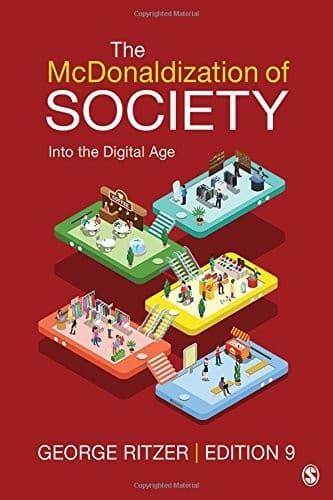
The Iron Cage Got a Subscription Model
George Ritzer has been updating *The McDonaldization of Society* since 1993, each edition bolting new examples onto Weber's iron cage like so many drive-through lanes added to a franchise. The ninth edition, subtitled *Into the Digital Age*, arrived in 2019 with the confident assertion that McDonaldization's center of gravity had migrated from the golden arches to Amazon.com. This was not wrong. What's striking from 2026 is how modest the claim now seems. Ritzer saw the platform economy as an intensification of existing rationalization — efficiency, calculability, predictability, control — and he was right to frame it that way. What he could not fully see was that the digital platforms he analyzed as exemplars of McDonaldization were about to be subsumed by something far more totalizing: generative AI systems that don't merely rationalize the consumer's experience but rationalize the consumer's cognition. The book's framework anticipated the what. It missed the velocity of the how.
The 2019 edition spends considerable energy on prosumers — people who both produce and consume, performing unpaid labor within systems designed to extract value from their participation. Self-checkout lanes, Uber drivers as "independent contractors," Airbnb hosts shouldering the operational burden. All of this has only deepened. But Ritzer's analysis assumed that prosumption was primarily about shifting labor costs. He did not account for the degree to which prosumers would become data feedstock. Every interaction with a McDonaldized digital platform now trains a model, refines a recommendation engine, or generates synthetic content. The consumer doesn't just work for free; the consumer *becomes the product and the production line simultaneously*. Ritzer gestured toward big data and algorithms, but his treatment reads as a chapter heading where a book was needed. The word "surveillance" appears, but surveillance capitalism as a structural force — the kind Shoshana Zuboff was already articulating — never gets the weight it deserves. This is the book's most conspicuous blind spot: it understood quantification as a cultural obsession but underestimated it as an extractive infrastructure.
Where the book lands hardest now is in its chapter on the irrationality of rationality. Ritzer's argument that rational systems produce irrational outcomes — inefficiency, dehumanization, homogenization, disenchantment — reads less like sociology and more like prophecy when held against the last seven years. The pandemic-era supply chain collapses were textbook irrationalities of rationality: systems optimized for efficiency shattered under the slightest perturbation. The current landscape of AI-generated customer service, where chatbots route you through seventeen menus to avoid employing a human, is the drive-through window taken to its logical and absurd conclusion. His observation that McDonaldization extends to birth and death hits differently after years of telemedicine triage and algorithmic hospice scheduling. The framework holds. It holds almost too well, which is both its strength and its limitation — it can describe nearly everything, which means it risks explaining nothing in particular.