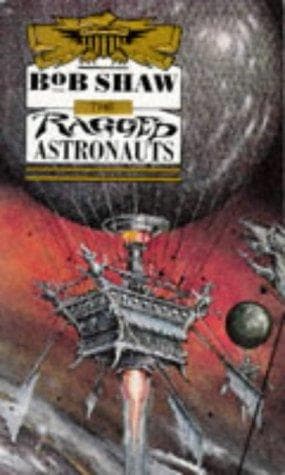
The Weight of Two Worlds and One Atmosphere
Bob Shaw's *The Ragged Astronauts* is a novel about people who decide to leave their planet by hot air balloon. Not metaphorically. They inflate enormous balloons, strap gondolas to them, and ascend through a shared atmosphere to a sister world hanging overhead like a rebuke. Published in 1986, it arrived in a decade drunk on cyberpunk chrome and digital futures, and Shaw — already an elder statesman of British SF — responded by writing a book about wood, gas, plague, and the politics of evacuation. He built a world where the most advanced technology is a heliograph and the most dangerous weapon is a tree. The result is a novel that reads, forty years on, less like retro-futurism and more like a parable we weren't ready to hear.
What Shaw anticipated is not any specific technology but a specific feeling: the political texture of civilizational emergency. The ptertha plague escalates in stages — first a manageable threat requiring buffer zones and specialized weapons, then a crisis that collapses agriculture, then an extinction-level event that forces mass migration. The institutional response follows a pattern we now recognize from lived experience: initial denial, grudging adaptation, factional exploitation, and finally a desperate logistical mobilization that is simultaneously too late and barely sufficient. Prince Leddravohr's arc — from skeptical military strongman to ruthless enforcer of an evacuation he privately dreads — could be mapped onto any number of twenty-first-century leaders who discovered that crisis management and authoritarian instinct are not the same skill. The religious backlash led by Lord Prelate Balountar, weaponizing popular resentment against the technocratic elite who designed the skyships, feels less like 1986 fantasy worldbuilding and more like a Tuesday. Shaw understood that when you tell people they must leave everything behind to survive, a significant percentage will choose to kill the messenger instead.
What he couldn't imagine, or chose not to, is equally telling. The migration is conceived and executed by a feudal aristocracy. There is no popular deliberation, no information commons, no distributed decision-making. Knowledge flows downward from Lord Glo to the King to the military apparatus. The people are cargo. This reflects both the genre conventions of planetary romance and, perhaps, a Cold War–era assumption that existential threats would be managed by centralized authority — that the real question was whether your elites were competent, not whether your systems were democratic. The women in the novel occupy a narrow band: Gesalla is sharp but largely reactive, Fera is a domestic complication, Daseene a passenger. Shaw was not unusual for 1986 in this regard, but it means the book's vision of survival is incomplete. It imagines who builds the ships and who flies them. It does not much imagine who decides whether the ships should be built at all, or what social contract governs the new world on the other side. Lain Maraquine's intellectual curiosity — his obsession with whether physical laws might differ on Overland — is the novel's most genuinely forward-looking impulse, and Shaw kills him for it, which may be the most honest thing in the book.