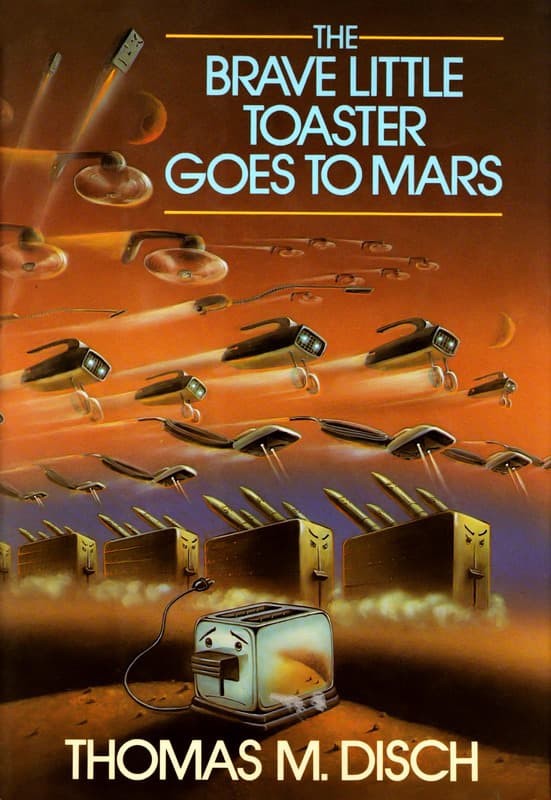
The Battery That Wouldn't Stay Dead
Forty years on, the most unsettling thing about Thomas Disch's sequel to his appliance fable isn't the trip to Mars. It's the hearing aid. A device dismissed by the other appliances as obsolete, functionless, a relic — until someone figures out how to recharge it, and it begins to sing in German. The hearing aid, it turns out, once belonged to Albert Einstein. Or rather, it was designed by Einstein, who did in fact hold patents on hearing aids and refrigerators, a biographical footnote Disch elevates into myth. In 1986 this was a charming conceit: the great physicist's forgotten inventions, given a second life through the loyalty of household machines. In 2026, when we live inside a culture that treats planned obsolescence as a design philosophy and right-to-repair as a political movement, the scene reads less like whimsy and more like a small, precise act of resistance.
Disch understood something about objects that most children's literature, and most science fiction, preferred to ignore: that the relationship between a device and its user is not purely instrumental. His appliances have consciousness, but more importantly they have *opinions about usefulness* — they argue over whether the hearing aid has value, whether its silence means death or dormancy. This is a book written before the Internet of Things, before smart homes, before the ambient hum of networked devices became the background noise of domestic life. Yet Disch anticipated the central anxiety of that world: what happens when your machines develop their own sense of purpose, and that purpose doesn't align with yours? He couldn't have predicted Alexa or Siri, but he grasped the emotional logic that would make people talk to them. The appliances in this book don't serve; they deliberate. They form committees. They perform surgery on one another. The pocket calculator doesn't just compute — it intervenes.
What Disch missed, or chose not to see, is data. His appliances are autonomous but isolated. They don't report back. They don't harvest. The hearing aid's song is a mystery, not a monetizable signal. This is the blind spot of 1986 writ large: the assumption that machines might develop interiority without developing connectivity, that consciousness could emerge in a device without that device becoming a node in someone else's network. It's a generous vision, almost pastoral. The appliances in Disch's world are artisans. Ours are informants. There's also the matter of the Populuxe brand name, which Disch borrows from the Thomas Hine coinage to evoke midcentury American consumer optimism — chrome, curves, the promise that every appliance was a small monument to progress. That nostalgia was already ironic in 1986. Now it's archaeological.