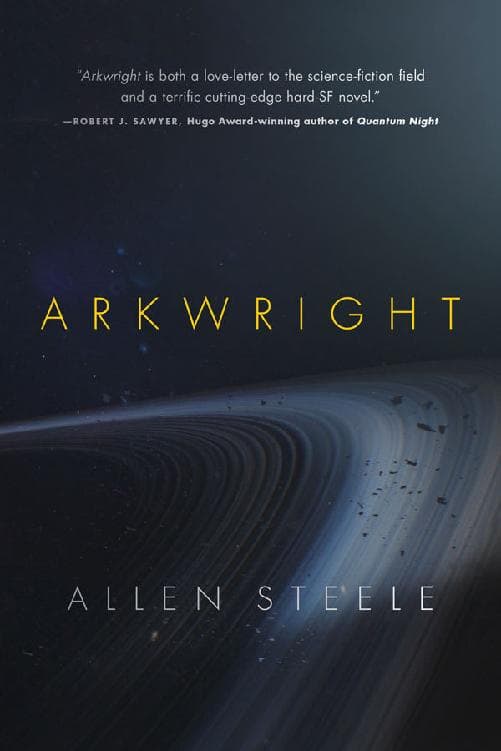
The Building That Outlived Its Architect
Nathan Arkwright dies in the opening pages, and the book spends the rest of its length arguing that this doesn't matter. What matters is the foundation he leaves behind — a multigenerational project to seed human life on a distant world, funded by the royalties of pulp science fiction. Allen Steele, writing under the Tor Books imprint of Tom Doherty Associates (a distinction worth noting, since the book is sometimes misattributed to Doherty himself), constructed something deliberately old-fashioned: a novel that believes in institutions, in patience, in the idea that a sufficiently stubborn vision can outlast the people who hold it. In 2016 this read as optimistic. In 2026 it reads as something closer to elegy.
The prescience is selective but real. Steele anticipated the privatization of deep-space ambition — the notion that a single wealthy individual's obsession could bootstrap an interstellar project where governments would not. We've watched this play out in degraded form: billionaire space ventures that promise the cosmos and deliver low-earth-orbit tourism, foundation-funded moonshots that generate more press releases than propulsion. Arkwright's fictional foundation is notably more disciplined than anything we've seen from the real donor class, which is either a credit to Steele's idealism or an indictment of ours. The book also gestures at the fragility of long-term projects — how they survive funding crises, generational turnover, loss of institutional memory. Anyone who has watched a promising research program get defunded mid-stride, or a space agency pivot with each new administration, recognizes the pattern. What the novel couldn't anticipate is how thoroughly the information environment would corrode the kind of shared purpose the Arkwright Foundation requires. It assumes a world where people can still agree on what constitutes a worthwhile future. That assumption now carries more weight than the antimatter drives.
The blind spots cluster around family and culture. Kate Morressy's strained relationship with her mother is rendered with care, but the multigenerational narrative that follows treats lineage as destiny in ways that feel increasingly uncomfortable. The right people are born, make the right choices, carry the torch. There is a tidiness to hereditary purpose that real families — with their addictions, estrangements, ideological fractures, and sheer entropy — rarely sustain. The book is also conspicuously quiet on the question of who gets left behind. An interstellar seed project is, by definition, a project for the chosen. Steele never seriously interrogates the ethics of a private foundation deciding humanity's cosmic future without democratic input. In 2016, this was a genre convention. In 2026, after years of watching unaccountable foundations reshape public policy, education, and health infrastructure, the silence is louder.