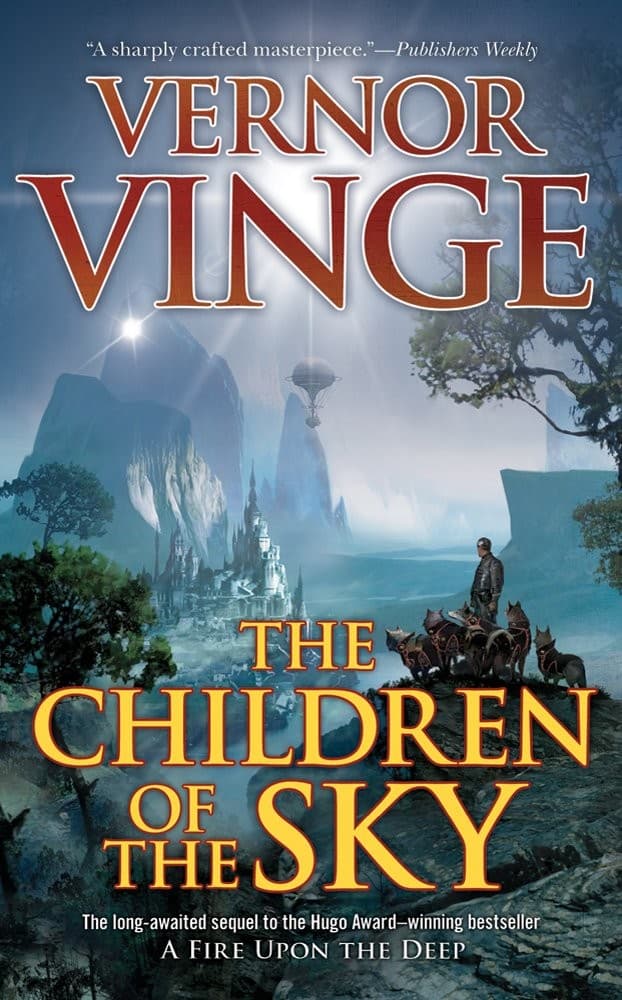
The Mindrot Was Already Here
Vernor Vinge spent his career circling one idea: that intelligence is the most dangerous resource, and whoever controls its allocation controls everything. In *The Children of the Sky* — and its predecessor *A Deepness in the Sky*, which this volume effectively continues and concludes — that idea takes the form of Focus, a viral technology that enslaves human minds into narrow channels of superhuman productivity. The Focused are called "zipheads." They are brilliant, obedient, and no longer fully persons. They form a hybrid layer between machine and human cognition, optimized by their masters for translation, code maintenance, surveillance. In 2011, this was a vivid science-fictional conceit. In 2026, it reads like a design document. The parallels to large language models and the humans who fine-tune, RLHF, and prompt them are not subtle. Vinge didn't predict the specific architecture, but he nailed the political economy: a small managerial class extracting cognitive labor from systems they don't fully understand, maintained through a combination of dependency and suppression. The deFocusing process — restoring autonomy to minds warped by years of directed cognition — now carries an unmistakable echo of debates about AI alignment, about what happens when you try to give agency back to something you've optimized for obedience. Trixia Bonsol's slow, painful reintegration into selfhood after years as a translation engine is the most emotionally precise thing Vinge ever wrote, and it lands harder now than it possibly could have in 2011.
What Vinge got right about power structures remains startling. The Emergent regime is a surveillance state built on plausible deniability and the rhetoric of cooperation. Tomas Nau's management style — the soft voice, the manufactured consensus, the way he frames every act of domination as a shared sacrifice — maps cleanly onto the language of platform capitalism and authoritarian technocracy as we've come to know them. The localizer network, a mesh of tiny sensors that enables both miraculous coordination and total panopticon control, anticipated the IoT-and-smart-dust discourse with uncomfortable accuracy. Vinge understood that the danger of ubiquitous sensing isn't the hardware; it's the asymmetry of who gets to query it. Pham Nuwen's covert mastery of the localizer network is the book's central power play, and it works precisely because no one else grasps the full topology of the system they inhabit. This is the world we live in now, where the gap between those who understand the stack and those who merely use it has become the defining political fault line.