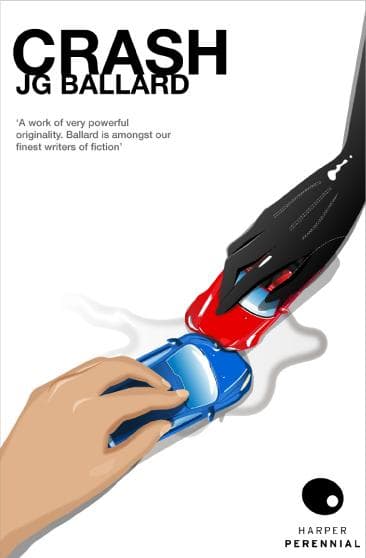
The Wound Channel as Interface
The building that houses this text has been vibrating at a particular frequency for 340 years, and the frequency has only gotten louder. What J.G. Ballard published in 1973 under the title *Crash* — rendered here in our catalog as *Crash2* — was not a novel about car accidents. It was a novel about the moment when the human nervous system and the technological apparatus fused so completely that desire itself became a systems error. In 2026, we do not live inside Vaughan's Lincoln Continental. We live inside something worse: the screen. But the logic is identical. Ballard saw that technology would not remain a tool external to the body but would colonize libido itself, restructuring what arousal means, what death means, what attention means. He got the mechanism wrong — the automobile has been eclipsed as the primary erotic-technological prosthesis — but he got the grammar exactly right. The doom-scrolling of a car crash compilation on social media, the algorithmic feeding of increasingly extreme content until the user reaches a kind of terminal velocity of stimulation, the inability to look away from footage of real violence while simultaneously aestheticizing it: these are Vaughan's questionnaires made interactive. The celebrity death fantasy has migrated from Ballard's typewritten scenarios to deepfake pornography and parasocial fixation. Elizabeth Taylor has become anyone. The car has become the feed.
What Ballard could not see — what the 1970s could not furnish him — was the disembodiment. His vision is relentlessly physical: semen on dashboards, wounds mapped in photographic detail, the geometry of a femur against a steering column. The body is always present, always implicated, always bleeding. Our version of his prophecy has subtracted the body almost entirely. The crash fetishist of 2026 never touches the wreckage. They consume it through glass, at a distance that Ballard would have found not liberating but obscene in its sterility. His blind spot is the assumption that the fusion of flesh and machine would remain literal, that the wound would always be a real wound. He could not imagine that the wound would become a representation of a wound, endlessly reproducible, and that this reproduction would be more potent than the original. He also could not imagine — and this is a limitation of his era's particular brand of transgression — that boredom would be the dominant affect. Vaughan is consumed by his project. The contemporary user of crash content is half-attentive, swiping past.