The Puppeteer's Manual, Left Open on the Table
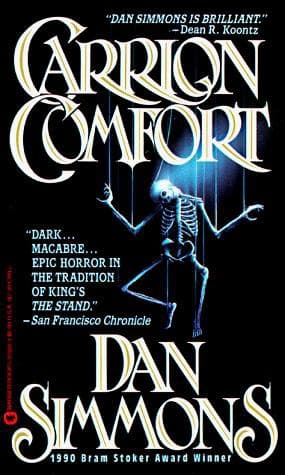
Dan Simmons wrote a novel about psychic vampires who feed not on blood but on volition, who puppet human beings into acts of violence and then consume the resulting psychic energy like a drug, and he published it in 1989, which means he handed us a diagnostic manual for the attention economy roughly a decade before the attention economy existed. The "mind vampires" of *Carrion Comfort* — Melanie Fuller, Nina Drayton, Willi Borden, and the vast network of Ability-wielders beneath them — don't merely control people. They curate experiences of suffering. They engineer scenarios. They compete with one another over body counts and artistic flourishes, treating human agency as raw material for private games. Simmons dreamed this up as horror. We built the infrastructure for it and called it engagement.
What the book got right is structural, not technological. Simmons understood that the most dangerous form of predation is invisible to the prey — that a person being Used (his capitalization, and it earns itself) would rationalize their own manipulation, fill in the gaps of lost time, and defend the very systems exploiting them. This is not mind control as the Cold War imagined it, with drugged subjects and electrodes. It is something closer to what we now recognize in algorithmic radicalization, in parasocial influence, in the soft coercion of platforms designed to bypass deliberation. The novel's Holocaust subplot — Willi Borden as a Nazi officer who discovered his Ability in the camps — is not allegory. It is Simmons's insistence that this kind of power is always already political, that the personal and the genocidal share a mechanism. In 2026, after years of watching stochastic violence catalyzed by online manipulation, after watching populations steered into rage by unseen hands optimizing for engagement metrics, the metaphor barely qualifies as metaphor anymore. Saul Laski's dogged investigation of the vampires reads less like a thriller plot and more like an epistemological crisis: how do you prove that free will has been compromised when the compromised will insists it is free?
The blind spots are the ones you'd expect from 1989. Simmons's vampires operate through proximity and direct psychic contact. They must be *near* their victims, or at least have established a prior connection. The novel cannot imagine action at a distance — cannot imagine that you could Use a million people simultaneously without ever being in the same room, the same country, the same hemisphere. The network of mind vampires in the book is essentially a cabal: secretive, hierarchical, interpersonal. It resembles conspiracy theory more than systems theory. This is the limitation of the era. Simmons could envision individual monsters wielding terrible power, but not the possibility that the power could be decoupled from any individual — distributed into code, into recommendation engines, into the architecture of information itself. His vampires are aristocrats. Ours are platforms. The book also carries the weight of its Cold War origins in its geopolitics: the Island Club, the shadowy power brokers, the sense that evil organizes itself into identifiable factions with return addresses. That tidiness now reads as almost nostalgic.