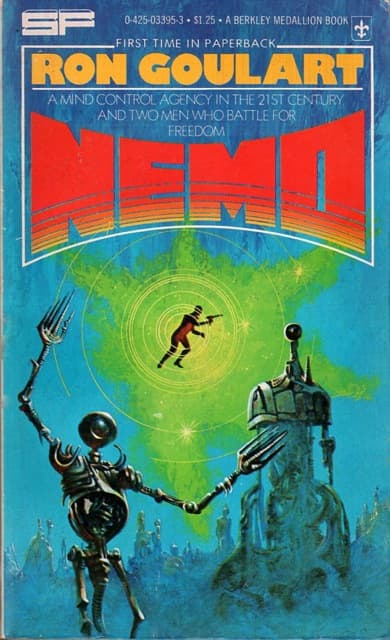
The Agency That Knew You Before You Did
Ron Goulart spent the 1970s writing science fiction the way some people tell jokes at funerals — with impeccable timing and zero reverence. *Nemo* is a slim, fast, darkly comic novel about a man who discovers he's been an unwitting government assassin, his telekinetic powers activated and directed by a clandestine agency without his conscious knowledge. The setup is pulp. The delivery is satirical. But in 2026, the skeleton of the thing keeps catching light. The Total Security Agency — a shadow bureau that recruits people with latent abilities, manipulates their behavior through conditioning and technology, then deploys them as deniable assets — reads less like paranoid fantasy and more like an organizational chart someone forgot to redact. Goulart didn't predict the specific mechanisms of modern surveillance capitalism or algorithmic behavioral nudging, but he nailed the underlying logic: that institutions would learn to exploit capacities in people that those people didn't know they had, and that the exploitation would be framed as service. Ted Briar doesn't know he's Agent Nemo. He just has bad dreams and a vague sense that something is off. Substitute "telekinesis" for "data profile" and the metaphor barely needs updating.
The domestic technology is where Goulart's prescience gets granular and his blind spots get instructive. The computerized house — a bed that monitors, a home that talks back, appliances that malfunction in ways that feel personal — is 2026's smart home rendered in 1977 plastics. The house computer that Haley interrogates about unauthorized access is functionally an Alexa with a worse personality. The "True-False MechanoTherapy" machine, a social-gathering novelty that evaluates the truthfulness of personal memories, anticipates both polygraph culture and the contemporary anxiety around AI-generated content and deepfakes eroding our confidence in what we remember and what actually happened. What Goulart couldn't see, or chose not to explore, was the voluntary dimension — that people would install these systems themselves, eagerly, and pay monthly for the privilege. His surveillance is imposed from above. Ours is opted into from below. The TSA in *Nemo* is a conspiracy. In 2026, the equivalent infrastructure is a terms-of-service agreement.
The social texture is period-specific in ways that both date the book and accidentally illuminate the present. The philosophy of "Selfism" — Dr. Perola's movement dismissing the past in favor of relentless future-orientation — was clearly a jab at the Me Decade's self-help culture, est seminars, and therapeutic narcissism. It now reads as a credible description of Silicon Valley ideology, the kind of forward-looking amnesia that treats history as technical debt. The scene where a Black man is subdued by police with an experimental stun gun during a lecture on self-improvement is handled with Goulart's characteristic flatness — it happens, people notice, the lecture continues. In 1977 this was social commentary delivered as background noise. In 2026, after decades of cell-phone footage and the normalization-outrage cycle, the flatness itself has become the point. The book's detached philosophy of self-interest amid global suffering, delivered through media snippets, is not a satire of the future. It is a photograph of the present. The implanted microminiaturized bomb in Haley — a literal kill switch placed inside a spouse to control an asset — is grotesque, but the principle of leveraging intimate relationships as vectors of institutional control is familiar enough to anyone who has watched how immigration enforcement, debt collection, or corporate non-compete agreements actually function.