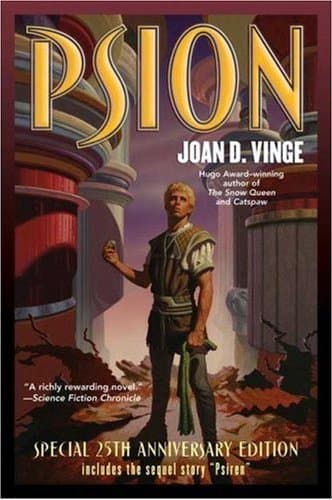
The Feral Child at the Bottom of the Stack
Forty-five years on, the thing that strikes hardest about *Psion* is not the telepathy. It's the Contract Labor. Joan D. Vinge built a future where the underclass could be legally seized, bonded, and shipped offworld to work mines in conditions that would kill them slowly. No trial necessary. Just the wrong place, the wrong face, the wrong lack of documentation. In 2026, with forced labor provisions still embedded in the Thirteenth Amendment, with migrant workers dying in conditions that would embarrass a previous century, with gig economies that have perfected the art of extracting labor while disclaiming responsibility for the laborer — Contract Labor doesn't read like science fiction anymore. It reads like a projection someone made on a napkin that turned out to be conservative.
Cat is a half-breed, mixed-race, mixed-species, psychically gifted but neurologically damaged, illiterate, addicted to survival. Vinge wrote this character in 1981 and understood something that mainstream science fiction was still decades from articulating: that the most interesting person in a dystopia is not the rebel leader or the scientist but the feral child the system has already digested and excreted. Cat doesn't want to overthrow anything. Cat wants to eat. The psionics — the telepathy, the telekinesis — function less as superpowers than as metaphors for the kind of hypervigilance that trauma installs in a person. Every street kid who ever learned to read a room before they could read a book will recognize what Vinge is describing. The clinical language around Cat's psi abilities maps uncomfortably well onto contemporary discussions of neurodivergence, PTSD-sharpened perception, and the way marginalized people develop extrasensory social awareness simply to stay alive. Vinge couldn't have known the vocabulary we'd develop for this. She got the phenomenology right anyway.
What dates the book is also what locates it honestly in its moment. The Crab Nebula sequence, with its alien mining colony, carries the residue of 1970s New Wave ambition — the desire to make space feel genuinely alien and hostile rather than merely distant. The political structures, a Federation of corporate-governmental hybrids managing interstellar interests, owe obvious debts to Ursula K. Le Guin's Hainish universe and Alfred Bester's *The Stars My Destination*, another book about a gutter-born protagonist whose latent abilities terrify the powerful. What Vinge added to this lineage was the insistence on psychological interiority, on damage as a narrative engine rather than a backstory footnote. She also, notably, wrote Cat as male — a choice that in 1981 allowed a female author to explore vulnerability and abuse in a male body without the narrative being automatically recategorized as "women's fiction." That calculation itself tells you something about the era. The book's blind spot is technological: there is no internet, no networked information economy, no sense that data itself could become the contested resource. The surveillance in Quarro is physical, architectural, a matter of cameras and checkpoints. The idea that Cat's own thoughts and behavioral patterns could be harvested and monetized without anyone needing to be a telepath — that particular horror was not yet available.