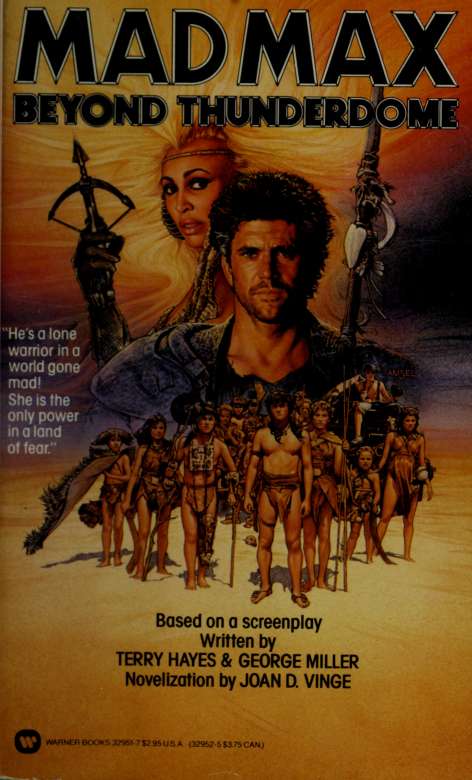
The Methane Under Everything
Joan D. Vinge's novelization of *Mad Max: Beyond Thunderdome* is, on paper, a hack job — a studio tie-in cranked out to meet a release window. That it transcends those origins even slightly is a testament to Vinge's genuine skill as a science fiction writer, her willingness to treat George Miller's mythic scaffolding as something worth inhabiting rather than merely transcribing. She lingers where the camera wouldn't. She gives Max an interior life that Mel Gibson's squint only implied. And in doing so, she accidentally produced one of the more useful documents we have about what 1985 thought collapse would look like — and how much of that thinking has aged into uncomfortable relevance.
The book's central prescience isn't nuclear war. That was the anxiety of its moment, the easy wallpaper. What holds up is Bartertown itself: a settlement powered entirely by methane harvested from pig waste, governed by a fragile détente between the person who controls the energy supply (Master) and the person who controls the political narrative (Entity). Vinge spells out this arrangement with more clarity than the film bothered to, and reading it in 2026, after years of watching petrostate leverage, energy blackmail between nations, and the bitter fights over who controls the transition to renewables, the metaphor doesn't feel like a metaphor. It feels like a diagram. Entity's famous declaration — "Who run Bartertown?" — is less a catchphrase than a thesis about how power launders itself through spectacle. Thunderdome isn't justice. It's content. Two men enter, the audience is pacified, and the energy keeps flowing. We have built several Thunderdomes since 1985; we just stream them.
What the book cannot see is information. There is no network, no signal, no data as a resource or weapon. The Tribe's oral tradition — the Tell — is treated as the only possible vessel for cultural memory after collapse, a kind of cargo cult built from fragments of airline safety cards and half-remembered television. It's a moving sequence, genuinely well-written, but it assumes that knowledge degrades only one way: into myth. The possibility that information might instead metastasize, that post-collapse societies might drown in noise rather than starve for signal, is wholly absent. Vinge's 1985 could imagine a world without fuel. It could not imagine a world without truth — or rather, a world so saturated with competing truths that the effect is the same as having none. The Tribe's problem is forgetting. Ours is the opposite.