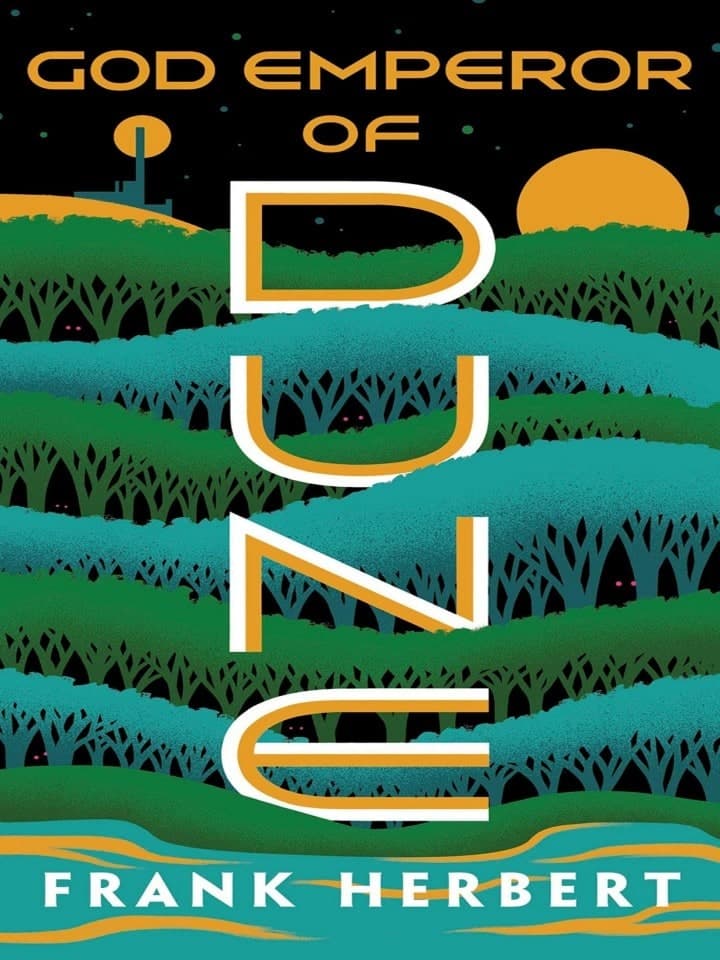
The Worm Turns Out to Be Right
Forty-five years after publication, *God Emperor of Dune* reads less like science fiction and more like a classified briefing someone leaked too early. Frank Herbert buried his most unsettling ideas in the most commercially hostile vehicle imaginable — a 400-page philosophical dialogue between a giant worm and a rotating cast of people who wish he'd shut up. Readers in 1981 largely recoiled. The adventure had curdled into seminar. But Herbert wasn't writing for 1981. Leto II's central thesis — that humanity will trade every freedom for safety, that peace itself becomes the instrument of stagnation, that a sufficiently long-lived ruler becomes indistinguishable from a god and a prison — now reads as a clinical description of systems we built ourselves. The "Golden Path" is Herbert's term for the evolutionary pressure that only comes from crisis, from scattering, from the refusal of any single point of control. In 2026, after watching algorithmic monocultures flatten discourse, after seeing how platform monopolies and surveillance states create the exact managed docility Leto cultivates in his Fish Speakers and Museum Fremen, the novel's warnings land with a specificity that feels almost rude. Leto's breeding program to produce humans invisible to prescience — humans who cannot be predicted or controlled — is Herbert's most radical claim: that the ultimate evolutionary advantage is illegibility to power. In an era of predictive policing, behavioral microtargeting, and AI systems trained to anticipate human choice before it's made, the idea that freedom requires the capacity to be unseen by the machine is no longer metaphor.
What Herbert got wrong, or rather what he couldn't see past, is the texture of the world that would validate him. His future is feudal, aristocratic, genetically obsessed — a universe where power flows through bloodlines and breeding programs, where women serve as either warrior-nuns or ambassador-weapons, and where the primary political actors are noble houses. The Fish Speakers are framed as an all-female military force whose loyalty derives from maternal instinct and sexual bonding — a thesis that felt reductive in 1981 and hasn't aged into sophistication. Herbert's gender essentialism, dressed up as evolutionary psychology, is the book's most persistent blind spot. He can imagine a man becoming a sandworm but cannot imagine women outside the categories of mother, seductress, or fanatic. The Bene Gesserit remain the most interesting female institution in the series precisely because they resist these frames, but even they are defined primarily by breeding utility. Similarly, Herbert's universe has no internet, no networked information systems, no social media — the Ixians are building a mechanical navigation computer and this is treated as the apex of technological subversion. The real Ixian threat in our world turned out to be not a machine that replaces the navigator but a feed that replaces the self.