The Astronomer at the End of the World
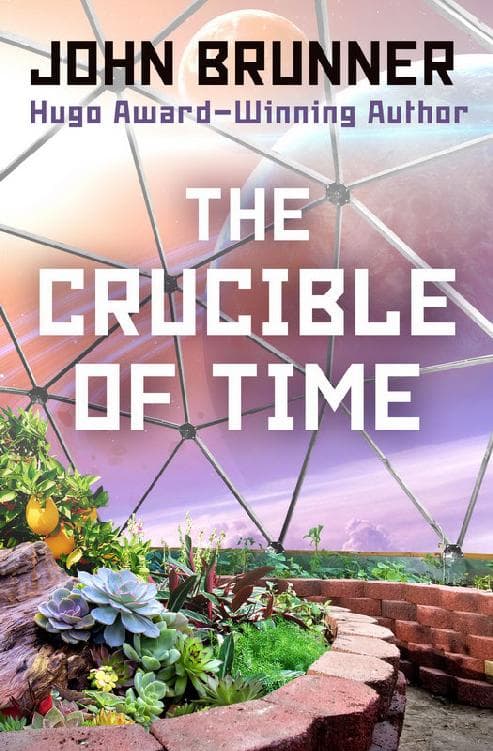
Brunner published *The Crucible of Time* in 1983, not 1976 — a correction worth making because the seven-year difference matters. By 1983, Brunner had already written his great prescient novels: *Stand on Zanzibar* (1968), *The Jagged Orbit* (1969), *The Sheep Look Up* (1972), *The Shockwave Rider* (1975). Those books anticipated overpopulation, media fragmentation, environmental collapse, and computer viruses with an almost reckless accuracy. *The Crucible of Time* is a different animal entirely. It steps sideways out of the near-future extrapolation game and attempts something older and stranger: a deep-time evolutionary epic told through alien civilizations struggling across geological ages to escape a planet doomed by its passage through a cosmic debris cloud. The chapter summarized here — the opening movement — gives us Jing, a court astrologer in a decaying civilization, trying to practice empirical observation in a culture drowning in superstition. It is, in miniature, the entire argument of the book.
What Brunner anticipated was not a specific technology but a specific mood. In 2026, we live inside Jing's problem. The data is there — climate projections, epidemiological models, orbital mechanics — and the political and social apparatus surrounding that data is a machine for ignoring it. Brunner understood that the obstacle to survival is not the absence of knowledge but the active hostility toward it, the preference for omens over observations. His declining Ntah, rife with exploitation and mysticism, reads less like alien worldbuilding and more like a Tuesday on social media. The "New Star" that Jing tracks — an indifferent cosmic event that a civilization insists on interpreting through the lens of its own anxieties — could be any number of things we've watched people refuse to see plainly in the last decade. Pandemics. Atmospheric carbon. The mathematics of exponential curves. Brunner did not predict the smartphone, but he predicted the person holding the smartphone and choosing to read horoscopes on it.
The blind spots are structural rather than ideological. Brunner's deep-time framework assumes that civilizations rise and fall in roughly analogous ways, that the arc of knowledge bends, however painfully, toward launch vehicles. It is a fundamentally Enlightenment narrative wearing alien skin. The possibility that a species might develop sophisticated technology and then *choose* to abandon the project of expansion — or that the project itself might be incoherent — doesn't really enter the frame. This is a 1983 sensibility: space as salvation, the stars as destiny. Forty-three years later, we have not returned to the Moon with crews for any sustained purpose, and the most visible space program is a billionaire's hobby crossed with a stock price. Brunner also cannot quite imagine information technology as the dominant force of change; his civilizations advance through biology, chemistry, astronomy, and engineering. The idea that a species might be transformed more by its communication systems than by its rockets was not yet fully available to him, even though *The Shockwave Rider* had touched its edges.