The Machine That Learned to Want
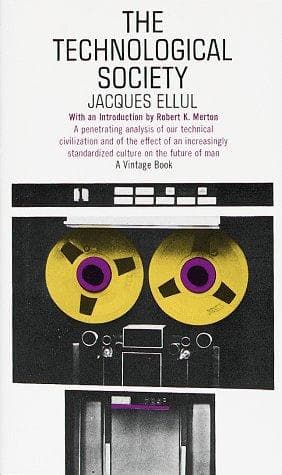
Ellul's central claim was never that technology is dangerous. That would have been manageable — dangers can be mitigated, risks calculated, safeguards installed. His claim was worse: that technique, his word for the totalizing logic of efficiency applied to every domain of human life, is not a tool at all but an environment. You do not use it. You inhabit it. And by 1964, he believed the habitation was already complete. Sixty-two years later, the most disorienting thing about rereading *The Technological Society* is not how much Ellul got right but how inadequate the word "right" feels. He did not predict the smartphone or the algorithm or the platform economy. He predicted the *condition* that made all of them feel inevitable the moment they arrived. The book's power was never in forecasting specific technologies; it was in describing a grammar of adoption that has not changed. Technique propagates itself. It selects for its own expansion. It reframes every human problem as a technical problem awaiting a technical solution. In 2026, with generative AI being deployed to automate legal discovery, medical diagnosis, military targeting, grief counseling, and the writing of book reviews, this reads less like social criticism and more like a systems manual someone left in the basement.
What Ellul got specifically, uncannily right: the convergence of state and technical apparatus without conspiracy, the reduction of political choice to managerial optimization, the way efficiency becomes a moral value that crowds out other moral values not by arguing against them but by making them irrelevant to the decision-making process. He described a world in which the question "Can we do this?" would permanently overwrite the question "Should we do this?" — not because people stopped caring about ethics, but because the technical system generates its own momentum and the ethical conversation always arrives after deployment. This is the precise structure of every major technology debate of the last decade: facial recognition, large language models, autonomous weapons, social media's effect on adolescent mental health. The pattern is identical each time. The technology ships. The discourse follows. The regulation, if it comes, regulates the last war. Ellul would not have been surprised. He would have been bored.
His blind spots are real, though, and they matter. Ellul wrote from within a European, Protestant, deeply patriarchal intellectual tradition, and his analysis carries those marks. He had almost nothing to say about race, colonialism, or the way technique was distributed unevenly across the globe — who builds the machines, who mines the cobalt, who lives downstream from the server farm. His vision of technique as a universal, homogeneous force flattens the politics of who benefits and who is ground under. He also could not have anticipated the degree to which technique would become participatory, even pleasurable. The citizen of 2026 does not merely submit to the technical system; she curates it, feeds it, performs herself through it, and experiences this as freedom. TikTok is not the totalitarian propaganda apparatus Ellul might have imagined. It is something harder to critique: a system people love, that loves them back in 15-second increments, and that reshapes attention, desire, and selfhood as a side effect of engagement metrics. Ellul understood coercion by efficiency. He did not fully reckon with seduction by convenience.