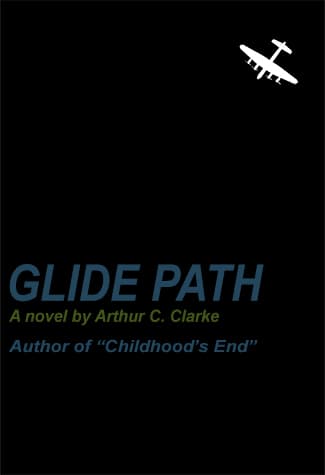
The Ghost in the Approach Corridor
Arthur C. Clarke wrote the future for a living, but in *Glide Path* he wrote the past — his own. This is his most autobiographical novel, thinly veiled as fiction, drawn from his wartime service developing Ground Controlled Approach radar at RAF airfields in 1943-44. It is also, by a wide margin, his least speculative work. There are no satellites, no monoliths, no transcendent aliens. There is fog. There is a cathode ray tube. There is a man talking a pilot down through soup so thick the runway lights are useless. And yet this book, precisely because it refuses to speculate, turns out to be one of Clarke's most prophetic. What he documented — the moment when human survival became dependent on trusting a machine's picture of reality over your own senses — is the foundational act of the world we now inhabit. Every autopilot, every GPS-guided approach, every autonomous vehicle negotiating an intersection in 2026 is a descendant of that moment when a pilot in zero visibility followed a voice reading numbers off a radar scope and put wheels on concrete he could not see. Clarke understood that the real revolution wasn't the machine. It was the surrender.
The technical details hold up with startling integrity. The resonant cavity magnetron, treated in the novel as a closely guarded secret ferried under armed escort, was indeed the key enabling technology — and its significance has only grown in retrospect as historians have come to regard it as one of the most consequential inventions of the twentieth century. The FIDO fog-dispersal system, which Clarke depicts in almost hallucinatory detail as walls of fire burning along the runway edges, was real and exactly as terrifying as he describes. The near-miss caused by radar echo confusion between two aircraft, and the subsequent scramble to develop an electronic beacon to distinguish the tracked plane, anticipates the entire lineage of transponder-based identification that culminates in modern ADS-B. Clarke even captures the organizational dynamics with uncomfortable accuracy: the civilian scientists who build the thing, the military bureaucracy that resists it, the moment of crisis that forces adoption, and then the institutional machinery that absorbs the innovation, files off the names of its creators, and calls it standard procedure. Anyone who has watched a Silicon Valley startup get acqui-hired will recognize the pattern.
What the book cannot see is equally instructive. The human in the loop is never questioned. Every landing requires a controller reading a scope and a pilot interpreting voice commands — the idea that the machine might close the loop itself, that the controller and the pilot might both become redundant, does not appear even as speculation. This is Clarke, the man who imagined geostationary satellites and space elevators, and he could not picture autoland. Or rather, he could picture it — he simply wasn't writing that book. He was writing an elegy. The Mark I system is already being replaced by the Mark II before the novel ends, and Alan Bishop's final scene is a visit to the decommissioned control van, mourning a machine he loved. Clarke's blind spot here is not technological but emotional: he assumes the human relationship with the instrument will always be this intimate, this craft-based, this personal. In 2026, a pilot on a CAT III ILS approach may never touch the controls at all. The fog is the same. The surrender is total. And nobody mourns the box.