The War the Collapse Didn't Need
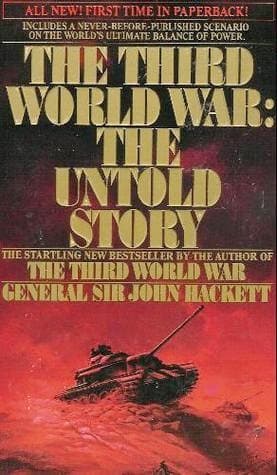
Minsk gets destroyed for reasons of narrative symmetry. Hackett's committee of retired officers is explicit about it: the city is chosen "because of its general comparability with Birmingham as the Soviet target" — not for what it holds strategically, but for what it will mean rhetorically, a provincial capital important enough to register in Moscow, unimportant enough to avoid the fast climb up the escalation ladder. That is the sentence that tells you what kind of book this is. Hackett commanded NORTHAG. The men he recruited to write individual chapters were air marshals and vice-admirals. This isn't a novelist imagining war; it's a general staff drafting the war it wants funded, with characters standing in for force postures and casualties standing in for line items. The fiction is the delivery mechanism. The argument — rearm, deploy the INF missiles, do not disarm unilaterally — is the payload.
What the book gets right is the fault line, not the mechanism. Chapter 21 and 23 lay out the Soviet Union's collapse along precisely the seams that opened in 1991 and tore wider in 2014 and 2022: Ukraine declaring independence and colliding with Romania over Odessa and the Dniester, Belorussia's western Catholics wanting Poland back, Crimean Tatars returning and refusing to stay Ukrainian, the Baltic states as "early candidates for freedom," Central Asian republics radicalizing off the spillover from Afghanistan. Kishinev, Lvov, Crimea — Hackett's committee named the exact towns that would still be contested forty years later. That specificity is not luck. It's what happens when people who study order-of-battle also read the ethnographic seams of an empire correctly.
But the book needed a war to unlock what it had already diagnosed as failing on its own. Chapter 22 catalogs agricultural stagnation, demographic exhaustion, ideological rot — a system, in Hackett's own telling, already coming apart from the inside. And then the plot insists four nuclear missiles and "the psychological shockwave" of a dead Minsk are required to release the nationalism that had, by his own account, "lain dormant" and ready. History skipped the missiles. The USSR came apart on schedule using exactly the fault lines Hackett mapped, and it didn't need Birmingham-for-Minsk to do it. The war turns out to be surplus to the argument the book itself already made. That's a strange thing for a piece of advocacy fiction to reveal about its own advocacy: the case for rearmament required a catastrophe that the diagnosis didn't actually depend on.