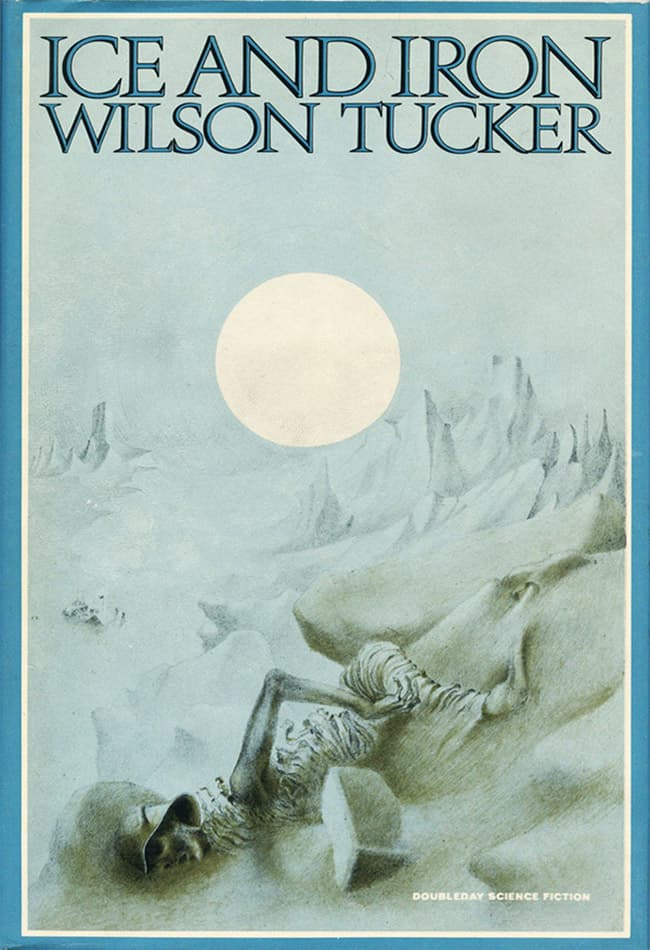
The Glacier That Came From Tomorrow
Wilson Tucker's *Ice and Iron* is a cold book in every sense. Published in 1974, when the "global cooling" hypothesis still had legitimate scientific currency, it imagines a new ice age swallowing Canada and pushing civilization southward — cities abandoned, populations resettled, the infrastructure of modernity buckling under advancing glaciers. The premise was not outlandish at the time. Temperatures had been declining since the 1940s, and a handful of climatologists were genuinely debating whether the interglacial party was ending. What Tucker did with this premise, though, was stranger and more interesting than simple disaster fiction. He threaded it with bodies falling from the sky, mud bricks from nowhere, artifacts from a parallel or future world bleeding into the present. The ice age becomes not just a catastrophe but a membrane — a thinning boundary between timelines. Reading it now, in 2026, when climate anxiety runs in the opposite thermal direction and the word "unprecedented" has lost all meaning, the book lands oddly. Tucker got the emotional architecture of climate disaster exactly right — the exhaustion, the bureaucratic paralysis, the way people throw farewell parties for doomed cities — while getting the specific disaster precisely backward. There is something almost cruel about that accuracy of feeling married to an inverted prediction.
What Tucker captured, and what resonates now with uncomfortable clarity, is the texture of living inside a slow-motion catastrophe. Highsmith's fatigue is not dramatic. It is the grinding, administrative fatigue of someone whose job is to measure the thing that is killing everything. He tracks the glacier's advance the way modern researchers track ice sheet collapse in Greenland and West Antarctica — with instruments, with data, with a growing sense that the numbers are outrunning the models. The blizzard that isolates the Regina base, the missing aircraft, the search parties tethered by lifelines — these scenes read like dispatches from any number of real polar research stations in the 2020s, where supply chains fray and the weather no longer behaves as expected. Tucker understood that the most terrifying aspect of environmental collapse is not the spectacular event but the logistical erosion: damaged equipment that can't be replaced, reinforcements that can't land, maps that arrive too late. That understanding has aged better than any specific prediction.
The parallel-world conceit is where the book gets genuinely strange, and where Tucker's ambitions outpace his execution. The bodies, the mud bricks, the polygon weapon that burns a hole in a ceiling — these elements suggest a post-glacial future leaking backward into the present, a world where ice-age survivors have devolved into tribal warfare with remnant technology. The chapters following the brickmaker, the boatman, the stalking hunter operate in a register closer to anthropological fiction than science fiction, depicting people who have adapted to a world after civilization's collapse. In 2026, this reads less like speculative fantasy and more like a grim extrapolation of what climate scientists call "cascading failures." Tucker couldn't have known about tipping points, about the Atlantic Meridional Overturning Circulation's potential shutdown — which, ironically, *could* produce severe regional cooling in parts of North America and Europe even as global temperatures rise. His ice age may yet arrive, just by a different mechanism than he imagined. The parallel-world framing, which might have seemed like a convenient genre device in 1974, now reads as an accidental metaphor for how multiple climate futures coexist in our models, each one bleeding artifacts — data points, projections, displaced populations — into our present.