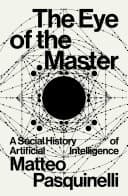
The Algorithm Was Always a Foreman
Matteo Pasquinelli's central provocation — that labour is the first algorithm — landed in 2023 as a corrective to the breathless mythologizing of large language models. Three years later, it reads less like a corrective and more like a diagnosis that arrived just before the fever broke. The book traces a lineage from ancient Hindu ritual mathematics through Babbage's Difference Engine, Marx's abandoned "general intellect," and Hayek's connectionist mind, arriving at the thesis that artificial intelligence is not an imitation of biological cognition but an encoding of social relations, specifically the division of labour. This is not a history of inventions. It is a history of how work was watched, parsed, and fed back into machines that then disciplined the workers. The eye of the master, the title's governing metaphor, is the gaze that decomposes skilled labour into reproducible steps — and that gaze, Pasquinelli argues, is what we now call AI.
What the book got right is almost uncomfortable. In 2024 and 2025, the explosion of AI-driven productivity tools did not eliminate cognitive labour so much as Taylorize it: breaking complex intellectual work into microtasks, routing it through algorithmic management systems, and extracting value from the cooperative intelligence of distributed human workers who increasingly cannot distinguish their own contributions from the model's. Pasquinelli's insistence that AI encodes "collective human knowledge and praxis" anticipated the legal and political battles over training data, the revolt of creative workers against generative models, and the dawning realization that the datasets are not raw materials but congealed labour. His excavation of Marx's shift from the utopian "general intellect" to the material "general worker" — the super-organism of humans and machines — now reads as a precise description of the hybrid production systems that dominate platform economies. The chapter on Hayek is particularly sharp in retrospect: the connectionist mind serving not industrial automation but market autonomy maps neatly onto the way AI has been deployed less to automate jobs than to automate market logic itself, optimizing pricing, surveillance, and the sorting of populations into tiers of economic utility.
The blind spots are structural rather than incidental. Pasquinelli's genealogy is resolutely European and Anglophone; the ancient Hindu mathematics of the Agnicayana serves as a gesture toward universality but remains an exception in a narrative dominated by Babbage, Marx, Hayek, McCulloch, and Pitts. The book could not have anticipated the speed at which Chinese AI development would complicate any social history rooted primarily in Western industrial capitalism and neoliberalism, nor the degree to which state-directed AI programs in the Gulf, India, and Southeast Asia would scramble the neat lineage from Enlightenment calculation to Silicon Valley connectionism. More pointedly, the book has little to say about the environmental costs of computation — an omission that felt minor in 2023 but now, after two years of data center buildouts straining electrical grids and water supplies across three continents, registers as a gap in the materialist analysis Pasquinelli otherwise champions. If labour is the first algorithm, energy is the first constraint, and the book does not reckon with it.