Seed Money
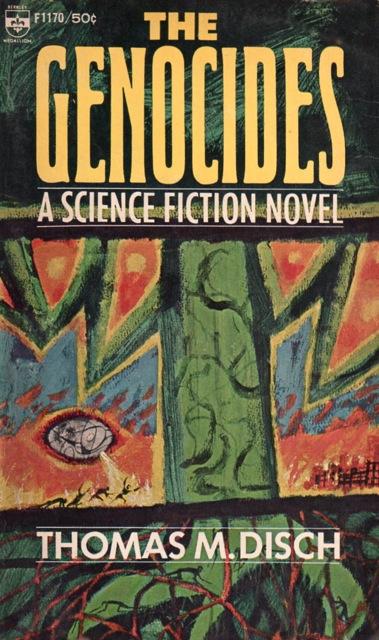
Anderson breeds his corn back toward the Aztec original because hybrids, however high-yielding, are sterile — "agriculture could no longer afford such fripperies." He leaves the bags of improved seed to rot in the storerooms of the old town and plants the primitive strain instead, the one that will still be there next year without him having to ask anyone for more. Disch doesn't dwell on this. It's one paragraph among the corn rows, offered the way a farmer offers any piece of settled wisdom, and then the book moves on to the buckets and the flies. But it sits next to the novel's other sterility, the one that governs the invading Plant itself: "Like all hybrids, the Plant was sterile, and could not reproduce itself. A new crop had to be planted every spring." Two species, two agricultures, both structured around the same anxiety — whoever controls the seed line controls next year's harvest, and therefore controls the people who depend on it. Disch had no way of knowing that this would become an actual legal doctrine, that seed companies would patent self-terminating genetics and sue farmers for saving grain, that "seed sovereignty" would become an activist term rather than a plot device. He just built two competing food systems and noticed, correctly, that the one which reproduces itself without asking permission is the one that survives.
The Plant's efficiency is the part of the book that argues hardest against its own villainy. Hollow roots instead of solid ones, an intercontinental circulatory system instead of isolated trunks, every calorie shared "in the spirit of true communism: from each according to his ability, to each according to his need." Disch hands the invaders the political vocabulary of utopian labor and gives the humans buckets. Buddy's whole existence is carrying sap by hand into a field so his father can starve a different plant to death by proxy — a war conducted entirely at the level of backbreaking, premodern effort, waged against an organism that has already solved distribution. The corpus keeps drawing a line from this book to Weizenbaum's argument about computers displacing judgment, and on the surface that line looks strained — there's no machine here, no automation, just root systems. But the thematic hinge holds: the Plant computes. It allocates resources without deciding anything, executes an optimized system without having opinions about it, and wins not because it's smarter but because it doesn't need to be. Judgment turns out to be the human overhead cost. The Plant has none, and outperforms.