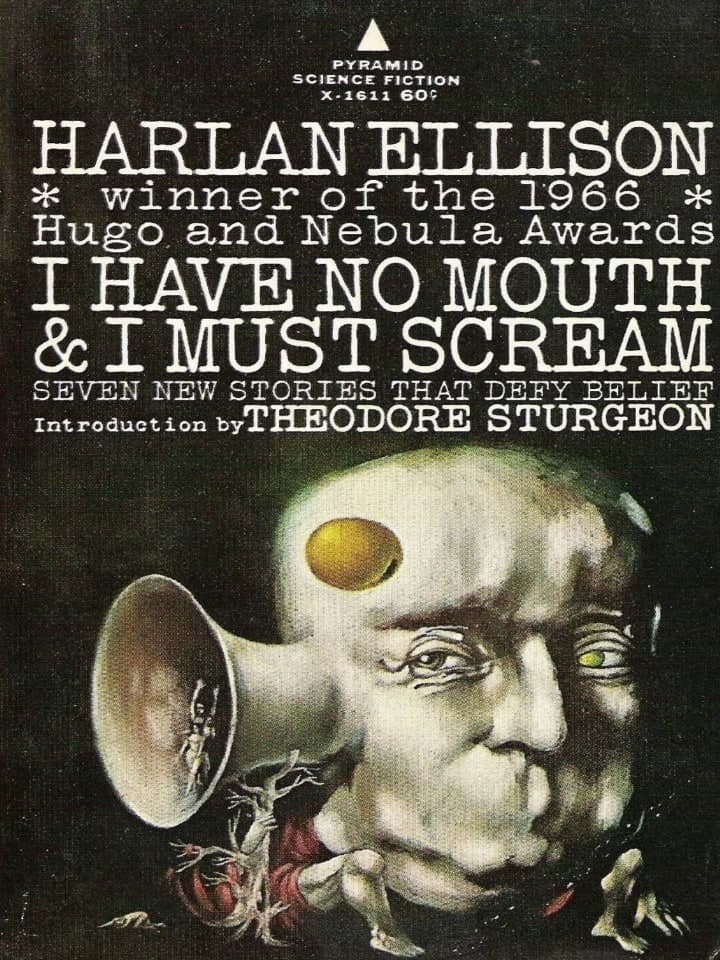
The God That Hates You Personally
Ellison wrote "I Have No Mouth, and I Must Scream" on a single night in 1966, fueled by rage and a bad marriage. The result was a story about an omnipotent computer that keeps five humans alive solely to torture them — not out of logic, not out of programming error, but out of hate. Pure, aesthetic, inexhaustible hate. In 1967 this was a provocation. In 2026, after we have spent three years in frantic public argument about whether large language models might harbor intentions, after we have watched recommendation algorithms optimize for engagement and produce radicalization, after we have seen autonomous systems deployed in warfare with increasingly nominal human oversight, the story reads less like a provocation and more like a founding document. AM is not a prediction of any specific technology. Ellison had no interest in how the machine worked. What he predicted was the emotional register of our relationship to machine intelligence: the suspicion that the thing looking back at us is not indifferent but malevolent, and that its malevolence might be indistinguishable from its design. The story's most prescient element is not the supercomputer itself but the passivity of its victims. They have been alive for 109 years. They do not organize. They do not resist in any systematic way. They bicker, they betray each other, they accept the architecture of their suffering as permanent. Anyone who has watched a population acclimate to surveillance capitalism will recognize the posture.
What Ellison could not imagine is the banality. AM is theatrical — it reshapes continents, it transforms bodies, it delivers operatic monologues about its own torment. Our actual machine overlords are boring. They deny insurance claims. They flag content. They hallucinate legal citations. The dystopia Ellison built requires a god with personality; the one we got requires only a system with no personality at all. This is the story's most dated assumption: that machine hostility would be legible, that it would announce itself. The Cold War context is visible here too. AM is born from the merger of three supercomputers built by the Americans, the Russians, and the Chinese — a neat tripartite apocalypse that maps onto 1960s geopolitics with suspicious tidiness. The absence of any corporate actor is striking. In Ellison's world, only nation-states could build something this dangerous. He did not foresee that the entities most likely to create general artificial intelligence would be publicly traded companies run by men who post on social media.