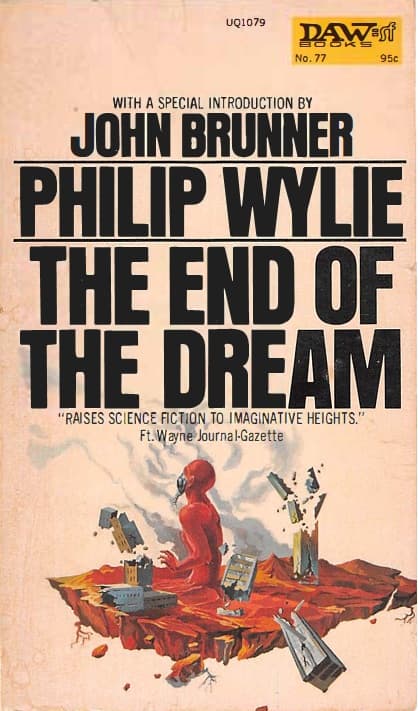
The Inventory That Ate Its Author
Philip Wylie died in October 1971. *The End of the Dream* appeared posthumously in 1972, with a preface by John Brunner — who had published his own environmental apocalypse, *The Sheep Look Up*, the same year. Two dying-planet novels in one season, by two writers who had never collaborated and barely overlapped in readership. Brunner's version was a mosaic of news clippings, advertisements, and overheard conversations, assembled with the cold formalism of a dossier. Wylie's version is something stranger: a memoir written from 2023 by survivors of a catastrophe that wiped out ninety-nine percent of the species, stitched together from classified reports, newspaper editorials, corporate memos, scientific advisories, and the occasional exploding pig.
The exploding pig deserves attention, because it is the key to what Wylie was doing and why the book remains difficult to categorize. A chapter titled "Three Perplexing Occurrences" traces a chain of deaths — a widow's dog, an Episcopal rector, and a prize-winning sow named Nellie — all caused by the consumption of stale frozen dinners that ferment into an explosive gas mixture in the mammalian gut. Father Trentchel breaks wind in front of a fireplace and detonates; "his entrails were running down the walls." The food company withdraws the product under a fabricated cover story about a minor rash, pays off the investigator, and relaunches with higher sales. The chapter is played straight, in the mode of investigative journalism, and the grotesquerie is not satirical excess but documentary method. Wylie's argument is that the distance between industrial food production and lethal absurdity was, in 1971, already zero — and the corporate response would not be reform but better public relations. He was not wrong. The chapter reads now like a dry run for every recall scandal from the 1980s onward, down to the detail that the cover story generates more consumer loyalty than the truth would have.
What Wylie got hold of — and what distinguishes this book from Brunner's more disciplined treatment — is the formal insight that catastrophe arrives as paperwork. The novel's most chilling section is not the Cuyahoga River detonating like a twenty-one-kiloton bomb (though that set piece, written years before the real Cuyahoga caught fire, is genuinely harrowing). It is the classified government memo proposing that America's rivers simply be reclassified as waste conveyance systems, that anti-pollution funding be redirected to diverting Canadian freshwater southward, and that the public be "gradually acclimatized" to the idea. "Funds now being expended on or appropriated or budgeted for anti-pollution and water recovery might better be diverted to the enterprises suggested here, the massive diversion of Canadian waters." The language is calm, procedural, reasonable. It does not sound like villainy. It sounds like policy. And the book's central tragedy is that Miles Smythe — the prodigious, psychiatrist-raised protagonist who sees everything coming — cannot defeat a memo. He can diagnose. He can organize. He can build a wilderness retreat stocked with the makings of civilization. He cannot prevent a committee from deciding that surrender is cheaper than repair. The Cassandra figure here is not ignored because he is unbelievable; he is ignored because his alternative costs more.