The Glass That Remembers Everything You Did
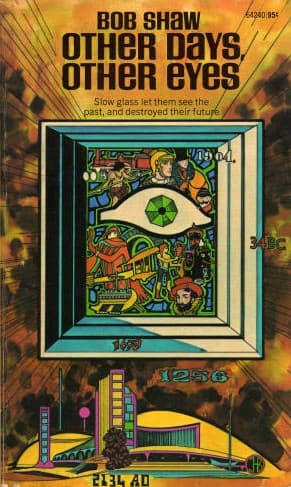
Bob Shaw's slow glass — glass that delays the passage of light, so that a pane installed in a countryside window might, years later, replay that pastoral view in a city apartment — first appeared in his 1966 short story "Light of Other Days," one of the cleanest thought experiments in the genre's history. *Other Days, Other Eyes* is the novel-length expansion, and it is both more ambitious and more troubled than the original conceit. Shaw takes his beautiful, melancholy idea and does the responsible thing: he follows it into surveillance, weaponization, political assassination, and the slow erosion of private life. In 1972, this was speculative. In 2026, it reads like a user manual for the world we built without the glass.
The prescience is startling in its structural accuracy, even where the details diverge. Shaw imagined a material that passively records everything light touches and can be triggered to release that information — essentially an ambient, always-on visual recording medium distributed through the built environment. We didn't get Retardite. We got Ring doorbells, dashcams, municipal CCTV networks, body-worn cameras, satellite imagery at sub-meter resolution, and smartphones in every pocket. Shaw's novel depicts a society where the expectation of privacy has been functionally destroyed not by malice but by the sheer ubiquity of a recording medium that people initially adopted for benign or even beautiful reasons. That trajectory — from aesthetic novelty to surveillance infrastructure — maps almost exactly onto the arc of the internet-connected camera. The detail about Retardite dust, particles of slow glass scattered to observe without visible apparatus, lands with particular force now that we live with devices small enough to be mistaken for lint. Shaw even grasps that the political class will simultaneously exploit and attempt to suppress these technologies: Senator Wescott is assassinated precisely because slow glass threatens to make certain secrets visible, and the cover-up involves destroying the glass itself. The parallel to modern battles over encrypted communications, leaked surveillance footage, and the selective deployment of body camera evidence is uncomfortably direct.
What Shaw could not imagine — and this is the era showing through — is the computational layer. His slow glass records, but it does not sort, search, correlate, or learn. There is no algorithm deciding which images matter. No facial recognition. No predictive model trained on the stored light. The terrifying thing about our actual surveillance infrastructure is not merely that it records but that it interprets, and Shaw's 1972 framework has no room for that second step. The novel also carries the period's assumptions about gender and domestic structure with a kind of unconscious fidelity: Esther Garrod is brave and long-suffering, Jane Wason is alluring and enigmatic, and neither woman exists except in relation to Garrod's needs and guilt. The marriage plot, meant to ground the technological speculation in human feeling, now reads as the weakest element — not because it's poorly written but because Shaw defaults to a model of domestic life where the wife's blindness becomes primarily a problem for the husband's conscience. The Pentagon scenes, the supersonic travel, the general Cold War architecture of the thriller elements all date the novel firmly, though not fatally.