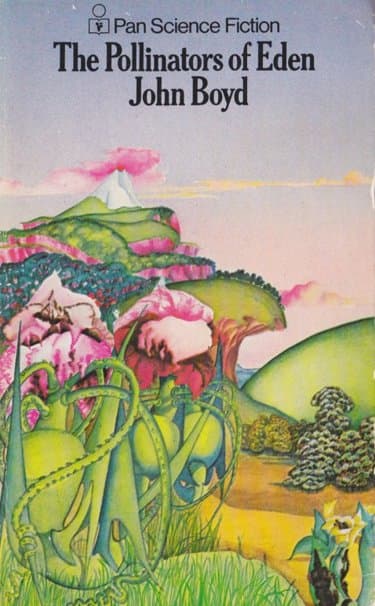
The Garden That Wanted You Back
John Boyd's 1969 novel operates under a deception so quiet you almost miss it: this is not a book about people studying plants. It is a book about plants studying people. The tulips of Flora communicate, adapt, select their pollinators, disperse their seeds through manipulated insect intermediaries, and — when pressed — kill. They function as a distributed intelligence, a collective brain wired through sound frequencies humans can barely detect. In 1969 this was speculative exotica, a conceit to hang a plot on. In 2026, after two decades of research into mycorrhizal networks, plant signaling molecules, and the acoustic emissions of stressed vegetation, it reads less like invention and more like a rough draft of findings that peer review is still catching up to. Boyd anticipated the broad shape of plant intelligence discourse — the work of Suzanne Simard, Monica Gagliano, the controversial but persistent claims about phytoacoustics — with an eerie specificity. He even intuited the political resistance such ideas would provoke: the Bureau of Linguistics refuses to analyze the tulip recordings properly, the Navy wants to spray the problem away, and the Senate committee dismisses Flora as a "pariah planet." The institutional immune response to paradigm-threatening biology is, if anything, understated here compared to the real thing.
Where Boyd's prescience sharpens, his social imagination blurs. Freda Caron is brilliant, driven, professionally accomplished, and yet the novel cannot stop framing her through the lens of her romantic attachments — to Paul, to Hal, to the planet itself, which her psychiatrist diagnoses as an "all-encompassing libido fixated on an entire planet." The men around her theorize; she reacts, facilitates, petitions. When she does act independently, the narrative treats it as a symptom. Doctor Campbell's Platonic dialectical method of psychiatric evaluation is really just a man explaining a woman's desires back to her in terms she's meant to accept. This is 1969's gender politics wearing a lab coat, and it dates the book more than any piece of speculative technology. Equally telling is what's absent: there is no consideration of indigenous or non-Western frameworks for understanding plant intelligence, no acknowledgment that entire philosophical traditions — animism, reciprocal ecology — had been saying something similar for millennia. Boyd's characters must arrive at these ideas through crisis and loss, as if the Western empirical tradition is the only door into the room.