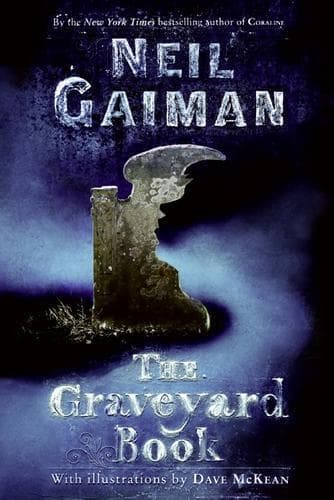
The Boy Who Was Raised by Everyone Who Ever Died
Gaiman wrote a Jungle Book with headstones instead of trees, and for a long time that was the whole conversation about this novel. Kipling's debt was acknowledged, the Newbery was awarded, and the book settled into the comfortable middle distance of modern children's literature — beloved, widely taught, not much argued about. But seventeen years is enough time for a graveyard to shift its meaning. Read now, The Graveyard Book is less a fairy tale about a boy raised by ghosts and more a quiet, almost accidental meditation on what it means to grow up in a community that is, by definition, unable to follow you into the future. The dead give Bod everything they have. It is not enough. It was never going to be enough. That inadequacy is the book's secret engine, and it hums louder in 2026 than it did in 2009.
What Gaiman anticipated, without quite naming it, is the particular loneliness of being formed by institutions and communities that cannot adapt. The graveyard's residents are frozen — not just temporally but ideologically. They teach Bod to read from gravestones. They offer him the Freedom of the Graveyard, a set of supernatural permissions that function nowhere else. Miss Lupescu's curriculum is exhaustive and entirely non-transferable. This resonates now in ways Gaiman likely didn't intend: a generation raised on platforms and pedagogies that dissolved beneath them, equipped with skills legible only within ecosystems that no longer exist. Bod's education is loving, rigorous, and almost perfectly useless outside its walls. The parallel to children raised inside algorithmic enclosures — literate in contexts that evaporate — is not subtle anymore, even if it was invisible in 2009. What Gaiman couldn't imagine, or chose not to, is that the boundary between the graveyard and the living world would become so porous. His model is still essentially Victorian: the dead stay put, the living move on. The notion that the dead might follow you out — that their voices, their images, their data might persist in your pocket, demanding ongoing relationship — belongs to a world the book doesn't anticipate. There are no digital ghosts here. The haunting is strictly local.
The book's blind spots are, in some ways, the blind spots of its genre. Bod's world is almost entirely white, almost entirely English in its assumptions about what a graveyard looks like and who inhabits it. The Jacks of All Trades, the sinister brotherhood pursuing Bod, are drawn from "diverse backgrounds" in the most superficial sense — a global conspiracy that nonetheless operates with the logic of a provincial thriller. Scarlett, the one character who might complicate the book's racial and cultural landscape, is handled with care but ultimately sidelined, her memory literally erased to preserve the narrative's tidy arc. In 2026, after years of conversation about who gets to be remembered and who gets forgotten — about whose graves are maintained and whose are paved over — that erasure reads less like narrative economy and more like a tell. The graveyard is a curated space. Someone decided who belongs there. The book never interrogates that.